
About
Pulsar Mouse
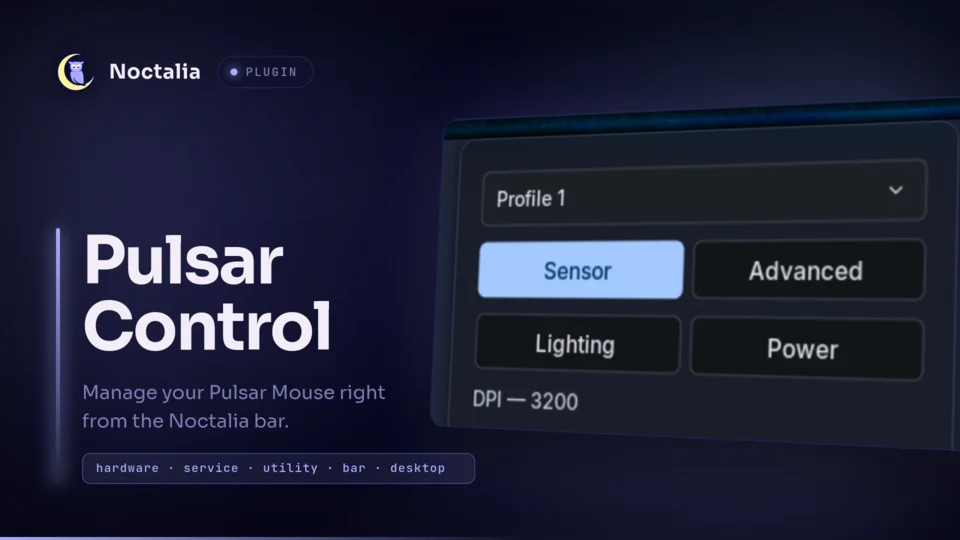
Bar and desktop widgets showing battery percentage and charging status (plus signal strength in the bar widget's tooltip) for a Pulsar gaming mouse (via pulsar-mouse-linux), plus a quick-controls panel - with a profile switcher, on a mouse with more than one onboard profile - covering DPI stage, polling rate, debounce, angle snap, ripple control, motion sync, lift-off distance, LED (effect/brightness/speed), and - on wireless mice - power saving/low-battery threshold. Since desktop widgets are shared with Noctalia's lock screen, the desktop widget shows up in both places once added. Works with just the pulsar-mouse CLI installed - the GUI/tray isn't required, it's just more efficient if it's running (see Data source).
Battery/signal only apply to wireless mice - on a wired one, the bar widget shows a plain neutral glyph (still clickable, to reach the panel) and the desktop widget shows a plain "Wired" placeholder instead. The controls panel's Sensor, Advanced, and Lighting tabs work for any mouse; the Power tab (wireless power saving, low-battery threshold) only appears for a wireless one.
Plugin
| Field | Value |
|---|---|
| ID | harveywuk/pulsar-mouse |
| Entries | Bar widget: bar; panel: controls; desktop widget: battery |
Requirements
- pulsar-mouse-linux installed, with
pulsar-mouseonPATH- every entry in this plugin shells out to it directly (see Notes for the full network/filesystem/process disclosure) pulsar-mouse-guirunning is optional but recommended (autostart) - see Data source
Usage
Updating
noctalia msg plugins update <source> only re-syncs files from a path/git source - it does not re-register a plugin's entries (bar widget, panel, etc). If an update adds or changes an entry, do a full disable/enable cycle afterward to pick it up:
noctalia msg plugins update pulsar-mouse   # or whatever you named the source
noctalia msg plugins disable harveywuk/pulsar-mouse
noctalia msg plugins enable harveywuk/pulsar-mouse
Bar Widget
Add the bar bar widget to your bar. Shows a battery glyph, icon-only, with a tooltip for the full status (percentage, charging, signal strength when available) - the glyph is the only thing rendered regardless of bar orientation; by default the glyph turns a secondary accent color while charging, or red once battery drops to the mouse's configured Low Power Mode threshold (see Controls Panel; falls back to 15% on a driver that doesn't expose that threshold, e.g. nordic.py) - each of those state colors is configurable, see Settings. On a wired mouse (no battery to show) it stays visible as a plain neutral glyph rather than hiding, since it's the only way to open the controls panel - DPI/lighting controls still work on a wired mouse, only the Power tab doesn't apply. If pulsar-mouse-gui isn't installed or running at all, this widget still works, it just always reads a fresh value directly from the mouse instead of the GUI's cached one (see Data source).
Controls Panel
Click the bar widget to open the controls panel. A Profile dropdown at the top (hidden on a single-profile mouse) switches the mouse's active profile - picking one calls --active-profile N and refreshes every field below, since profile switches affect essentially everything shown, not just DPI/LED. Below that, tabs (Noctalia has no native tabs control - these are just segmented buttons swapping which section renders):
Sensor
- DPI - a slider stepping through the active profile's configured DPI stages (not a raw DPI range - every position lands on an actual configured value, like a notch per stage)
- Polling Rate - a slider the same way, stepping through the device's supported rates
- Lift-off Distance - a slider, in mm (only shown for a driver with a continuous LOD range, like the Feinmann 8K's 0.7-2.0mm in 0.1mm steps - a driver with a fixed discrete LOD list instead isn't currently supported by this panel)
Advanced
- Debounce - a slider, in ms
- Angle Snap, Ripple Control, Motion Sync - toggles
Lighting
- LED Effect - a dropdown (off/steady/breathe, or whatever the device supports)
- Brightness - a 0-100% slider
- Speed - a 0-100 slider for the LED effect's speed, shown only when the current effect actually has one (e.g. breathe, not steady)
Power (wireless mice only)
- Wireless Power Saving - a slider, 30s-15min, shown as M:SS
- Low Power Mode - a slider, 0-100% battery threshold
All of these write straight through the pulsar-mouse CLI immediately on release (sliders commit on drag-end, not live per pixel) - unlike the battery reading, none of this lives in the cached state file, so the panel always talks to the mouse directly.
You can also open the panel over IPC:
noctalia msg panel-toggle harveywuk/pulsar-mouse:controls
Desktop Widget
Add the battery desktop widget from Noctalia's desktop-widget editor (it's then also available for the lock-screen widget editor).
Data source
The bar and battery entries both read battery percentage/charging/low-power-threshold from the reading pulsar-mouse-gui already writes on its periodic poll (~/.cache/pulsar-mouse/battery.json) rather than polling the mouse themselves, so they don't double up on USB traffic. If that file is missing or older than 3 minutes - the GUI isn't installed, isn't running, or was just closed - each falls back to its own direct pulsar-mouse --battery-json call instead, so both still work standalone, just with their own USB round-trip each tick. Signal strength is bar-only (the desktop widget doesn't currently show it) and has no synchronous getter besides - it only ever arrives via an async event the GUI listens for, so it's only available through the cached file, never the CLI fallback. The low-power threshold, unlike signal, does have a synchronous getter, so it's available via both paths, for both entries.
Settings
Bar Widget
| Setting | Type | Default | Description |
|---|---|---|---|
glyph_size |
int |
16 |
Glyph size, 10-32. |
normal_color |
color |
on_surface |
Glyph color at a normal battery level, and on a wired mouse. |
charging_color |
color |
secondary |
Glyph color while charging. |
warning_color |
color |
error |
Glyph color at or below the Low Power Mode threshold. |
error_color |
color |
error |
Glyph color when the mouse or the CLI can't be found. |
Desktop Widget
| Setting | Type | Default | Description |
|---|---|---|---|
color |
color |
primary |
Accent color for the percentage text and progress bar at a normal battery level. |
charging_color |
color |
secondary |
Used while charging. |
warning_color |
color |
error |
Used at or below the Low Power Mode threshold. |
error_color |
color |
error |
Used when the mouse or the CLI can't be found. |
show_progress |
bool |
true |
Shows or hides the battery-level progress bar. |
show_percent |
bool |
true |
Turn off to rely on just the glyph and progress bar. |
glyph_size |
int |
28 |
Glyph size, 16-64. |
The four state colors are per-widget, so the bar and desktop widgets can differ. All of them (bar's normal_color included) sit behind the settings UI's advanced toggle, except the desktop widget's color. The defaults reproduce exactly what these were before they were configurable, so an existing setup looks unchanged until you touch one.
The normal-state setting is called normal_color on the bar widget but color on the desktop widget. That asymmetry is deliberate: a bar widget's plugin settings share a TOML table with Noctalia's own per-widget presentation settings, where color is already taken ("Color role for this widget's icon and label"). A plugin declaring color there does not shadow it, it aliases it - one key backs both pickers, so setting either silently moves the other. Desktop widgets have no such clash, and renaming that one would break existing configs.
Notes
- No network access. Every entry talks only to the local
pulsar-mouseCLI (a spawned process, never a daemon) and, for the bar/desktop widgets, reads a local cache file. - Spawns
pulsar-mousefor every read and write - DPI/polling/LED/etc. changes in the controls panel, and the battery-json fallback read in the bar/desktop widgets when the cache is stale or missing. - Writes nothing itself.
~/.cache/pulsar-mouse/battery.jsonis written bypulsar-mouse-gui(a separate program from this plugin, part of the samepulsar-mouse-linuxproject) on its own periodic poll - this plugin only ever reads that file, never writes it. - Requires Wayland/Hyprland (or another wlroots-based compositor) like the rest of Noctalia - no compositor-specific behavior beyond that in this plugin itself.
Versions
| Version | Plugin API | Updated |
|---|---|---|
| v1.7.0 latest | 9 | Aug 11, 2026 |
Older versions stay installable on a Noctalia release whose plugin API is below the latest version's.