
About
Gamer Mode
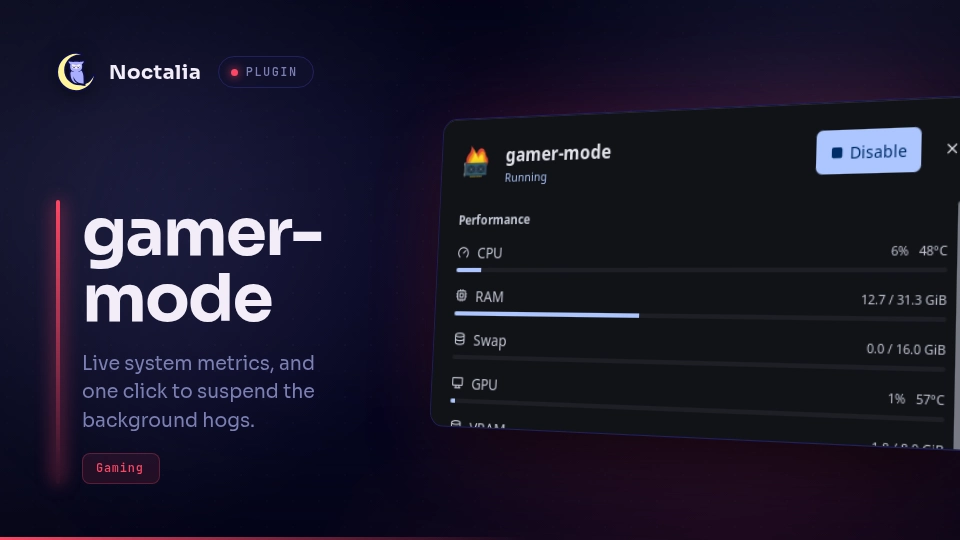
Live CPU, RAM, and GPU readings in the bar, plus a one-click mode that suspends background resource hogs and restores what was running before.
Requires Noctalia v5 and plugin API 19. Noctalia v4 uses a different QML plugin format and will not list or load this source.
Plugin
| Field | Value |
|---|---|
| ID | nomadcxx/gamer-mode |
| Entries | Bar widgets: gamermode, monitor; panel: main; service: service |
Requirements
pgrepandpkillfrom procps probe and signal process targetssystemctlcontrols service and timer targetsdockercontrols container targetspowerprofilesctlfrom power-profiles-daemon switches the power profile
Each tool matters only if you target that kind. Without powerprofilesctl the
panel hides its power row and the toggle still works.
Usage
| Gesture | Action |
|---|---|
| Left-click | Opens the panel. Set Left-click action to toggle to toggle instead. |
| Right-click | Toggles gamer mode, whatever Left-click action says. |
The glyph takes the accent colour while gamer mode runs. Its tooltip shows the live readings in an aligned table and ends with gamer-mode state.
The panel shows a bar per reading, the power profile selector, the suspend profile selector, what the plugin has suspended, and the maintenance actions.
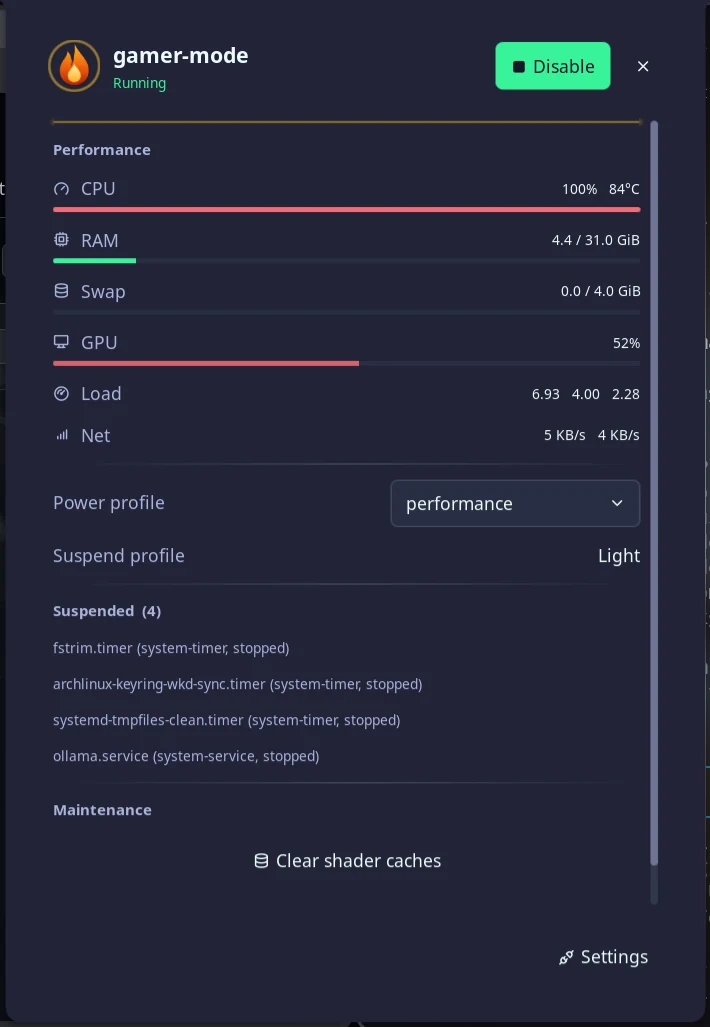
Running under load. CPU and GPU sit past their thresholds, so their bars have warmed; RAM and swap have not. The halo rings the mark, the ember sits under the header, and the suspend profile shows as a label because the session already recorded one.
Pick light or heavy in the panel and press Enable, and that profile applies
for the session. A plugin reads its own settings and cannot write them, so the
choice rides along with the enable rather than changing the Gamer mode
profile setting. While gamer mode runs the selector gives way to a label,
because the session already fixed the profile. To change it, disable first.
Drive it from a shell or a keybind:
noctalia msg plugin nomadcxx/gamer-mode:service all toggle
noctalia msg plugin nomadcxx/gamer-mode:service all enable
noctalia msg plugin nomadcxx/gamer-mode:service all disable
Toggle the panel:
noctalia msg panel-toggle nomadcxx/gamer-mode:main
Monitor
Add the monitor widget when you want the readings on the bar. Keep the
gamermode widget for a compact toggle icon. Both entries use the same click
actions: left-click follows Left-click action, and right-click toggles gamer
mode.
The monitor groups related readings in a fixed order. A metric shown on the bar stays out of its tooltip, so hovering adds the disabled readings instead of repeating the row. The tooltip always includes gamer-mode state and the number of suspended targets. Vertical bars stack each reading and omit the flame.
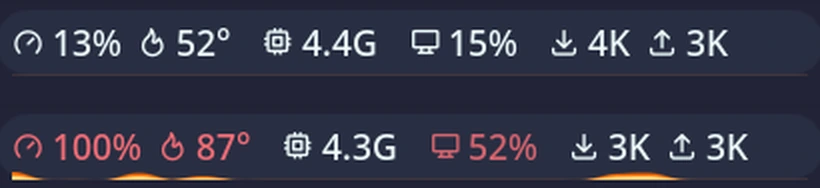
Gamer mode off above, running under load below. The flame is lit, and the readings past their thresholds have warmed toward the highlight colour.
The pill
The monitor draws no background of its own, for the same reason the shell's
built-in sysmon widgets do not: the bar draws it. Turn it on the way you would
for any widget and the shell frames the readout in the same stadium capsule,
sized and centred by the bar rather than guessed at by the plugin:
[widget.gamermonitor]
type = "nomadcxx/gamer-mode:monitor"
capsule = true
capsule_fill, capsule_padding, capsule_radius, and capsule_opacity work
here as they do elsewhere. The monitor can also join a capsule_group, sharing
one capsule with the sysmon widgets beside it.
Values hug their text by default, so the readout is exactly as wide as its readings and grows as network rates change. Reserved value width trades that for a steady width: set it to the widest reading you expect and values right-align inside the reservation instead of pushing their neighbours. It sets a floor rather than a clamp, so nothing gets truncated.
Warning colours
Each reading warms towards the theme's error colour as it climbs, holding its
normal colour below an activity threshold and saturating at a critical one. The
thresholds are the shell's own defaults for each metric: 50%/90% for CPU,
60°C/85°C for temperatures, 1/50 MB/s for network. A monitor grouped beside the
built-in sysmon widgets therefore warms in step with them.
| Monitor setting | Default | Description |
|---|---|---|
| CPU usage | On | Shows processor load. |
| CPU temperature | On | Shows processor temperature. |
| RAM used | On | Shows used memory in GiB. |
| Swap used | Off | Shows swap percentage when swap exists. |
| GPU usage | On | Shows graphics load when the shell reports a GPU. |
| GPU temperature | On | Shows graphics temperature when available. |
| VRAM used | Off | Shows used video memory when available. |
| Load average | Off | Shows the one-minute load average. |
| Network rates | On | Shows aggregate download and upload rates. |
| Icons | On | Places a glyph beside each reading. Turn it off for numbers only. |
| Reserved value width | 0 |
Pixels held for each reading. Zero lets values hug their text. |
| Highlight while gamer mode is on | On | Adds the flame band under the readings. |
| Flame height | 5 |
How tall the flame band is, in pixels (2-12). See the note below on why the useful range is small. |
| Flame | flare |
off, a 900 ms flare, or always. |
| Flame style | graph |
One graph node, or 28 sharper bars. |
The widget holds the band's slot open whether or not it burns, so toggling gamer mode never shifts your readings. It reserves an equal gap above them to match the band below, which keeps them centred in the pill instead of pinned to its top edge.
That is why the band stays small. On a 42px bar at the default capsule thickness
of 0.76, the pill measures 32px inside and the readings take 22, leaving 10 to
split between the gap and the band. Ask for more than half and the flame lands
outside the pill.
Raise capsule thickness in your bar settings if you want a bigger flame. It
sets the pill's height, so a taller pill gives you a taller band: at 0.95 the
pill runs about 40px and fits 9px of flame with the readings still centred.
While gamer mode is on
A ring wraps the panel mark and thickens as load climbs, and a soft ember pulses under the header. The panel's vsync frame tick drives each of them, and the shell stops that tick when you close the panel, so an idle or closed panel costs nothing.
The mark ships as two files, one dark ramp and one light, and the shell picks between them by dark mode. A plugin cannot read palette colours, so those stay a fixed pair instead of following your theme.
always holds the widget at about 30 frames per second while gamer mode runs.
Noctalia keeps widget timers running when another window covers the bar, so
this setting consumes CPU during play. flare returns to a one-second idle tick
after 900 ms.
Maintenance
Three one-shot cleanups sit at the foot of the panel. None of them is part of gamer mode, and turning gamer mode off does not undo any of them.
| Action | What it does | Needs a password |
|---|---|---|
| Clear shader caches | Deletes the Mesa, NVIDIA GLCache, RADV, and Steam shader caches |
No |
| Drop page cache | sync, then vm.drop_caches=3 |
Yes |
| Reclaim swap | swapoff -a && swapon -a, pulling swapped pages back into RAM |
Yes |
Clearing shader caches takes two clicks. The first measures and the button reports the size, the second deletes. Games recompile shaders on their next launch, so that launch is slower. This is the one to reach for when a driver update leaves stale shaders behind.
The plugin expands every cache path from a fixed list and drops any that
resolves outside your home directory, so the rm only ever sees the paths
above, and only those that exist.
Dropping the page cache frees the RAM the kernel uses to cache files. The kernel
refills it, and the pages it discards are ones it would otherwise have reused, so
this buys less than the number in free suggests.
Reclaiming swap only runs when what is swapped out fits in free RAM with a tenth of total held back. Otherwise it reports that there is no room and does nothing, because succeeding into an out-of-memory kill would defeat the point.
Settings
| Setting | Default | Description |
|---|---|---|
| Bar icon | device-gamepad-2 |
Glyph shown in the bar. Names a glyph from the shell's registry. |
| Custom icon | Empty | SVG or PNG used instead of the glyph. File changes reload in the bar. |
| Custom icon, gamer mode on | Empty | Optional active-state image for the toggle. |
| Left-click action | open_panel |
Opens the panel or toggles gamer mode. Right-click toggles either way. |
| Poll interval | 3 |
Seconds between metric updates: 2, 3, or 5. |
| Gamer mode profile | light |
Selects which target profile a toggle applies. |
| Auto performance profile | On | Switches to the performance power profile while gamer mode runs, then hands back the previous one. |
| Show temperatures | On | Includes CPU and GPU temperatures in the tooltip and panel. |
| Suspend targets (JSON) | Empty | Replaces the built-in target list. See below. |
The setting names the profile a bar click applies. The panel selector overrides it for the enable it is sent with, and the bar's right-click toggle does not see that selection, so it uses the setting.
Noctalia cannot tint a custom image. Set Custom icon, gamer mode on if the toggle needs a distinct active state; otherwise it reuses the resting image and reports state in the tooltip.
Target list
targets takes a JSON array. Each entry needs a match, a kind, and the
profiles it belongs to. action is optional.
[
  {"match": "awww-daemon",     "kind": "process",        "action": "freeze", "profiles": ["light", "heavy"]},
  {"match": "qbittorrent",     "kind": "process",        "action": "freeze", "profiles": ["light", "heavy"]},
  {"match": "ollama.service",  "kind": "system-service", "action": "stop",   "profiles": ["light", "heavy"]},
  {"match": "fstrim.timer",    "kind": "system-timer",   "action": "stop",   "profiles": ["light", "heavy"]},
  {"match": "brave",           "kind": "process",        "action": "freeze", "profiles": ["heavy"]},
  {"match": "jellyfin.service","kind": "system-service", "action": "stop",   "profiles": ["heavy"]}
]
An empty setting uses the built-in list: 173 entries, 94 of them in light.
Breadth costs almost nothing, because a target that is not running probes as
down, so the plugin never touches it and never restores it. An entry for
software you do not have costs one pgrep.
The plugin falls back to the built-in list when the setting holds invalid JSON or when every entry in it fails validation, and logs the reason. It drops single bad entries and honours the rest, so one typo costs you one target.
match compares through pgrep -x, so it needs the whole name. Substrings and
patterns do not match. The plugin quotes every value for the shell and refuses a
match holding a newline, carriage return, or NUL at parse time.
Actions
action defaults to stop.
stop |
freeze |
|
|---|---|---|
| Mechanism | pkill / systemctl stop / docker stop |
SIGSTOP / docker pause |
| Probes | read-only, never elevated | read-only, never elevated |
| Frees RAM | Yes | No, pages stay resident |
| Frees VRAM | Yes | No |
| Halts CPU use | Yes | Yes |
| Halts disk I/O | Yes | Yes |
| Keeps state | No, the target shuts down | Yes, the target resumes where it stopped |
| Restarts | Units, timers, and containers | Always |
Pick freeze for anything you return to: a browser, an editor, a wallpaper
daemon. Pick stop when you need the memory back. A local model runtime such as
ollama holds VRAM until the service stops, and freezing keeps every VRAM page
allocated, so those targets use stop.
Network connections drop while a target sits frozen. That suits a torrent client and hurts a chat app.
Kinds
kind |
Probe | stop |
Start | freeze |
Thaw |
|---|---|---|---|---|---|
process |
pgrep -x |
pkill -x |
none, see below | pkill -STOP -x |
pkill -CONT -x |
user-service |
systemctl --user is-active |
systemctl --user stop |
systemctl --user start |
systemctl --user kill --kill-whom=all -s SIGSTOP |
same with SIGCONT |
system-service |
systemctl is-active |
pkexec systemctl stop |
pkexec systemctl start |
pkexec systemctl kill --kill-whom=all -s SIGSTOP |
same with SIGCONT |
user-timer |
systemctl --user is-active |
systemctl --user stop |
systemctl --user start |
invalid | invalid |
system-timer |
systemctl is-active |
pkexec systemctl stop |
pkexec systemctl start |
invalid | invalid |
container |
docker inspect -f '{{.State.Running}}' |
docker stop |
docker start |
docker pause |
docker unpause |
Timers
Stopping foo.service leaves foo.timer free to fire it again five minutes into
your session, so scheduled work needs its own target. A stock Arch install
enables fstrim.timer, smartd.timer, paccache.timer, and the package-cache
timers, and each one stalls disk I/O mid-game.
The timer kinds require the .timer suffix on match. systemctl is-active fstrim resolves to fstrim.service, so the plugin rejects a timer entry without
the suffix at parse time.
Processes do not restart
kind: "process" has no start command. A bare process name carries no argv, no
environment, and no working directory, so the plugin cannot relaunch one. That
makes process with action: "stop" a one-way trip. The plugin allows it and
logs a warning, and every built-in process entry uses freeze. To get something
back, target the unit or container that supervises it.
Protected targets
The plugin refuses some targets whatever the setting says, because stopping them ends your session, kills your audio or network, or kills the game gamer mode serves. It drops such an entry at parse time with a logged reason, and every command builder refuses it again at action time, so a session file written by an older version cannot act on one either.
session/display  niri hyprland sway river wayfire labwc gnome-shell kwin_wayland
                 plasmashell Xorg Xwayland greetd sddm gdm
the shell        noctalia quickshell
audio            pipewire pipewire-pulse wireplumber pulseaudio
core IPC         systemd systemd-logind dbus-broker dbus-daemon elogind
network          NetworkManager wpa_supplicant iwd systemd-networkd
game stack       steam steamwebhelper gamescope wine wineserver proton lutris
                 heroic bottles gamemoded
Matching ignores case and any .service, .timer, or .socket suffix, so
Steam, steam, and steam.service all fail. The list takes no override. A
wrong entry here costs you a dead session or a killed game, and an override field
is the one people copy from a forum post without reading. To act on one of these,
use Feral GameMode's start= and end= script hooks in gamemode.ini.
System units ask for a password once
Stopping or starting a system unit needs authorisation. The plugin runs all the
units of one operation through a single pkexec /usr/bin/systemctl call, which
asks once and then does the whole batch as root.
Two simpler approaches were measured first and each cost a password prompt per unit, seven units meaning seven dialogs:
- One
systemctlper unit. polkit'sauth_admin_keepretains an authorisation against the subject that gave it, and the subject systemd reports is the calling process, so seven processes are seven subjects with nothing to reuse. - One
systemctlnaming all seven units. systemctl issues itsStopUnitcalls in parallel, so every polkit check is outstanding before any of them has an answer, and again nothing can reuse an authorisation that does not exist yet.
org.freedesktop.policykit.exec is auth_admin with no retention, so each
pkexec prompts. The built-in targets only ever stop system units and never
freeze them, so an enable costs one prompt and a disable costs one. A custom
target list that mixes stops and freezes pays one prompt per operation.
Without pkexec the plugin falls back to calling systemctl directly, which
still works through systemd's own polkit check at the cost of the prompt-per-unit
behaviour. It logs the downgrade at startup.
You need an authentication agent running for any prompt to appear. Most desktops start one; standalone compositors often do not. Check with:
pgrep -af 'polkit.*agent'
If nothing is listed, install one such as mate-polkit, polkit-gnome or
hyprpolkitagent and start it with your session. Without an agent the calls fail
and each one is logged.
To skip the prompt entirely, grant the units you target. Scope the rule to those
units: a blanket rule lets anything running as you stop or start any system unit.
In /etc/polkit-1/rules.d/49-gamermode.rules:
polkit.addRule(function (action, subject) {
    var units = ["sonarr.service", "radarr.service", "fstrim.timer"];
    if (action.id == "org.freedesktop.systemd1.manage-units"
        && subject.isInGroup("wheel")
        && units.indexOf(action.lookup("unit")) >= 0) {
        return polkit.Result.YES;
    }
});
Targets left out of the built-in list
Each of these suits someone and makes a poor default. Paste what you want into
targets.
Voice chat. Freezing these cuts voice during the activity the plugin serves.
{"match": "discord", "kind": "process", "action": "freeze", "profiles": ["heavy"]},
{"match": "vesktop", "kind": "process", "action": "freeze", "profiles": ["heavy"]},
{"match": "slack", "kind": "process", "action": "freeze", "profiles": ["heavy"]},
{"match": "element-desktop", "kind": "process", "action": "freeze", "profiles": ["heavy"]}
Music. Plenty of people game with music playing.
{"match": "spotify", "kind": "process", "action": "freeze", "profiles": ["heavy"]},
{"match": "spotifyd.service", "kind": "user-service", "action": "stop", "profiles": ["heavy"]},
{"match": "mpd.service", "kind": "user-service", "action": "stop", "profiles": ["heavy"]}
Recording and streaming. Plenty of people stream the game they play.
{"match": "obs", "kind": "process", "action": "freeze", "profiles": ["heavy"]},
{"match": "gpu-screen-recorder", "kind": "process", "action": "freeze", "profiles": ["heavy"]}
Language runtimes. java, dotnet, and node burn CPU, and they run games
too. Minecraft and every PrismLauncher or MultiMC instance runs as java. Unity
and .NET titles run as dotnet. Freezing those freezes the game. Add them only
if nothing you play uses them.
Container and VM daemons. Stopping docker.service takes down every
container, and starting it again leaves their previous states behind. Stopping
libvirtd kills running guests. Target single containers with
kind: "container", which pauses and unpauses through the cgroup freezer.
Shared databases. Other services tend to depend on postgresql, mysqld,
and redis. The built-in heavy profile does cover elasticsearch and
opensearch, whose JVM heaps often top the RAM table on a development box.
VRAM without stopping the daemon. ollama unloads models while staying up.
No target kind covers this, so use a Feral GameMode hook:
[custom]
start=/usr/bin/ollama stop --all
Restore semantics
Enabling writes a session snapshot to the plugin data directory
(session.json). For every target in the active profile it records whether the
target was running or active or already down, which action applied, the
power profile in effect, and the kernel boot ID.
The snapshot lands on disk before anything is suspended. It is the only record of what was running beforehand, so a target suspended without one is unrecoverable: disable would read the session, find none, and return. If the write fails, enabling stops there with the machine untouched and tells you why.
Disable runs two passes, because the two actions need different logic.
The plugin probes each stop target again and starts it back when it is
still down. So it leaves alone anything you stopped before enabling gamer mode,
and anything you restarted by hand while gamer mode ran. It logs and skips a
missing unit or container, and never fails hard partway.
The plugin thaws every freeze target without probing. A frozen process
still appears in pgrep, so no probe distinguishes "still frozen" from
"running", and SIGCONT to a process that is not stopped exits 0 and changes
nothing. Thawing blind beats probing here: it cannot misread a state, cannot
stomp a manual restart, and cannot leave something frozen after a probe fails to
run.
The snapshot sits on disk, so gamer mode survives a shell restart. Reload Quickshell mid-session and the panel still reports it as on with the same suspend list, and disable still restores.
Enabling twice does nothing. A second enable would re-probe and record the targets it had suspended as "was down", losing what it needs to restore them.
After a reboot
A session file outlives a reboot, so the plugin compares the boot ID at startup. A different ID means the session went stale: nothing that was frozen still exists, and units that were stopped may have come back on their own.
A stale session gets a full restore pass before the plugin clears it. A stopped
unit that is not enabled is still down after a reboot, and putting it
back is what you were told would happen. Frozen targets died with the reboot, so
their thaw does nothing. This can fire a few systemctl start calls
soon after login, and the plugin logs each one.
Within the same boot the plugin always keeps the session, even when everything looks like it is running, because that is the case where something may still sit frozen and need thawing. A session written before version 0.2.0 carries no boot ID, and the plugin treats it as current so it does not abandon targets that may still be suspended.
Notes
- The plugin stores its session snapshot in Noctalia's plugin data directory. It makes no network requests.
reniceis absent by design. It looks like the safe middle ground and is not. WithRLIMIT_NICE=0, the default, an unprivileged process lowers priority and never raises it back, so a renice would degrade every process it touched for the life of that process.freezegives you the reversible option instead. Feral GameMode needs membership in agamemodegroup to renice at all for the same reason.- No I/O weighting for user units. cgroup v2 delegates
cpu,memory, andpidsto the user manager, and notio. - The toggle widget carries the readings in its tooltip. The monitor shows your selected readings in the bar and puts the rest in its tooltip.
- The panel shows no per-core CPU breakdown and no top-process list.
- Nothing places the widget on your bar for you. The manifest has no field for a default bar section, and a plugin can read its settings but not write them, so bar layout stays yours. Add it under Settings → Bar.
- VRAM appears where the shell reports it, which means NVML on NVIDIA.
- The plugin toggles no compositor effects. Animations, blur, and shadows belong to your compositor's own config.
- Feral GameMode exposes a
ClientCountproperty that emits changes and aGameRegisteredsignal oncom.feralinteractive.GameMode, andorg.scx.Loaderswitches sched_ext schedulers. Arming gamer mode from either one would work and is not built.
License
MIT
Versions
| Version | Plugin API | Updated |
|---|---|---|
| v0.7.0 latest | 19 | Aug 10, 2026 |
Older versions stay installable on a Noctalia release whose plugin API is below the latest version's.