
About
Crashes
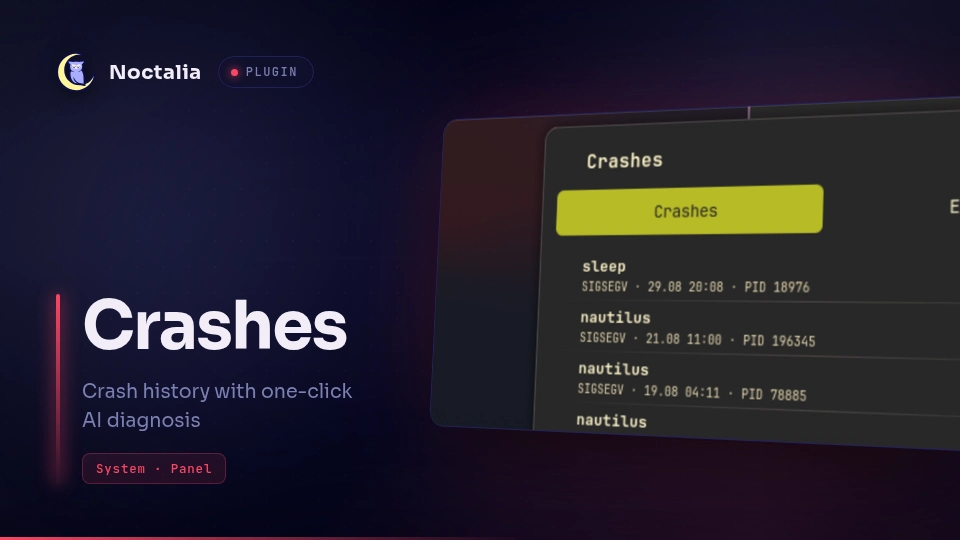
Crash history for your desktop, read from systemd-coredump, with one-click AI diagnosis. When one of your processes segfaults or dumps core you get a critical notification, and the panel keeps the list around afterwards — so a crash you missed while watching a video is still there when you come back to it. A second tab shows the current boot's journal errors by severity.
Plugin
| Field | Value |
|---|---|
| ID | umedbazarov/crashes |
| Entries | Panel: panel; service: service |
Requirements
coredumpctl(systemd-coredump) active and collecting — the default on Arch and most systemd distributions; verify withcoredumpctl list.jq, required — filters the coredump list to your own crashes outside the plugin runtime.notify-send(libnotify), required for the crash notifications.bash, required — runs the diagnosis command.A terminal AI coding agent for the diagnosis buttons (Claude Code, Codex, opencode, grok, …). Without one the panel still works as a crash and error browser; the diagnosis button then explains what to install.
Whichever of those are installed are tried in turn: before the window opens the agent is asked a throwaway question, and one that cannot answer — out of quota, logged out, offline — is skipped in favour of the next. You see which was chosen in the terminal itself. Turn that check off with Check the agent can answer if you would rather not spend the request, and set the order with Agent order. A configured Agent command is used on its own: its headless syntax is unknown, so it cannot be tested the same way.
gdband your distribution's debuginfod are optional, but the guide the agent follows uses them to symbolize a backtrace when they are available.
Usage
The plugin has no bar widget. Open the panel from the plugin's row in Settings, or bind it in your compositor:
noctalia msg panel-toggle umedbazarov/crashes:panel
Crashes lists the coredumps of your own processes, newest first: program, signal, time, PID, and whether the core file still exists (rotated-away dumps are marked and cannot be analyzed). Each row has two buttons:
- Diagnose (stethoscope) opens your agent in a terminal with the recorded
facts and
diagnose.md, an evidence-first investigation guide: readcoredumpctl info, rule out OOM kills, correlate the timestamp with filesystem mtimes, the journal and recent package updates, symbolize the backtrace with gdb + debuginfod, and report honestly — including what the evidence does not show. The guide explicitly tells the agent to leave the system as it found it. - Mute (bell) stops notifications for that one program; press it again to unmute. Mutes are kept in the plugin's data directory.
Errors shows this boot's journal entries at a chosen severity — err and
stricter by default, up to emerg only — with the same diagnosis button per
entry, which asks the agent to pull the surrounding journal context and
explain what the message means and how serious it is.
Only your own crashes are listed (matched by uid): a system daemon dumping core is a sysadmin's problem, not a desktop notification.
Settings
| Setting | Type | Default | Description |
|---|---|---|---|
poll_seconds |
int |
20 |
How often the coredump list is re-read. |
notify |
bool |
true |
Announce new crashes with a critical notification. Turn off if something else already announces them. |
agent_cmd |
string |
(empty) | Command that receives the prompt as its last argument, e.g. claude, codex, opencode --prompt. Empty: pick from the known agents (see below). |
agent_order |
string |
(empty) | Which known agents to try and in what order, e.g. codex, claude. Empty: claude, opencode, codex, grok. |
probe_agent |
bool |
true |
Check that the agent can answer before opening it, and move on to the next one if it cannot. |
extra_prompt |
string |
(empty) | Text appended to every prompt — e.g. "Answer in German", or house rules for the agent. |
terminal_cmd |
string |
kitty -e |
Wrapper that opens the agent in a window. Leave empty if your agent command opens its own window. |
env_file |
string |
(empty) | Sourced before the agent starts. For a proxy or an API key your shell profile sets but a panel click does not inherit. |
IPC
noctalia msg plugin umedbazarov/crashes:service all refresh
Re-reads the coredump list immediately instead of waiting for the next poll.
Notes
- Commands spawned.
coredumpctl list --json=shortpiped throughjq(the crash list),id -uonce at startup (only your uid's crashes are shown),journalctl -b -p <level> -o jsonpiped throughjqfor the Errors tab — and only when that tab is open,notify-sendfor notifications, andsetsid bash -c …to launch the agent in a terminal when you press a diagnosis button. Nothing runs an agent on its own. - Files written. Only in the plugin's data directory:
seen.json(the newest crash already announced, so a restart does not re-announce old ones) andmutes.json(the per-program mute list). - No privileges. Everything runs as your user; the plugin never modifies system configuration and never touches the dumps themselves.
- What is sent to the agent. The crash facts shown in the row (program, PID, binary path, signal, time) or the journal line you clicked, plus the path to the bundled guide. Whatever the agent then reads is up to it and your agent's own permissions — the guide keeps it to read-only investigation, and warns that a core dump is a verbatim copy of process memory that may contain secrets.
- Budget-friendly. Filtering happens in
coredumpctl/jqoutside the Luau runtime, at most 30 rows are parsed per poll, and the Errors tab is only queried on request.
License
MIT.
Versions
| Version | Plugin API | Updated |
|---|---|---|
| v1.0.0 latest | 9 | Aug 30, 2026 |
Older versions stay installable on a Noctalia release whose plugin API is below the latest version's.