
About
Claude Companion
A Noctalia v5 plugin that puts Claude Code's live status on your desktop — a pulse on the bar, a breathing orb on the desktop, and an answer panel for quick questions.


Claude Code is a brilliant agent trapped in a text box. It can't see the windows you have open, can't tap you on the shoulder when it hits a wall, and gives you nothing to glance at while it churns. So you sit there watching a terminal, or you wander off and miss the moment it needed you.
This plugin gives it a body. It wires Noctalia into Claude's lifecycle so a pulse on your bar tracks every session, an orb on your desktop breathes along with the work, and an answer panel catches one-shot replies before they scroll away. The terminal keeps doing the actual thinking — permissions, tools, MCP, all native. This is just the nervous system that lets the rest of your desktop feel it.
Don't run Claude Code? The signal bus is agent-agnostic — any agent, CI job, or shell script that can run a command on its own lifecycle can light up the same bar. See Wiring up other agents.
Plugin
| Field | Value |
|---|---|
| ID | lowcache/claude-companion |
| Entries | Services: pulse-svc, claude-ask; bar widget: pulse; desktop widget: orb; panels: answer, sessions, consent, ask; launcher: claude |
| Launcher Prefix | /claude |
Built and live-tested against Noctalia 5.0.0 (build 623210223c), with an offline widget spec suite keeping the state machine honest.
See it
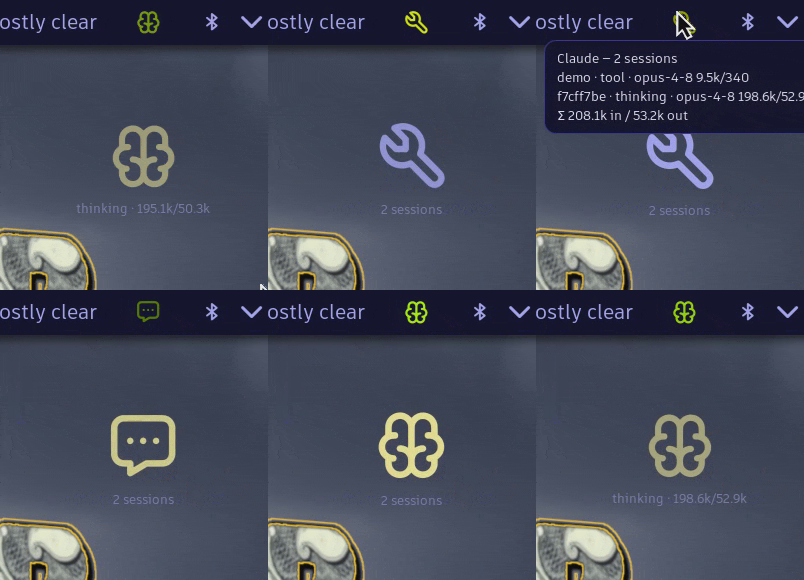
One session, start to finish: the pulse on the bar and the orb on the desktop breathe through idle, thinking, a tool run, done, and needs-you.
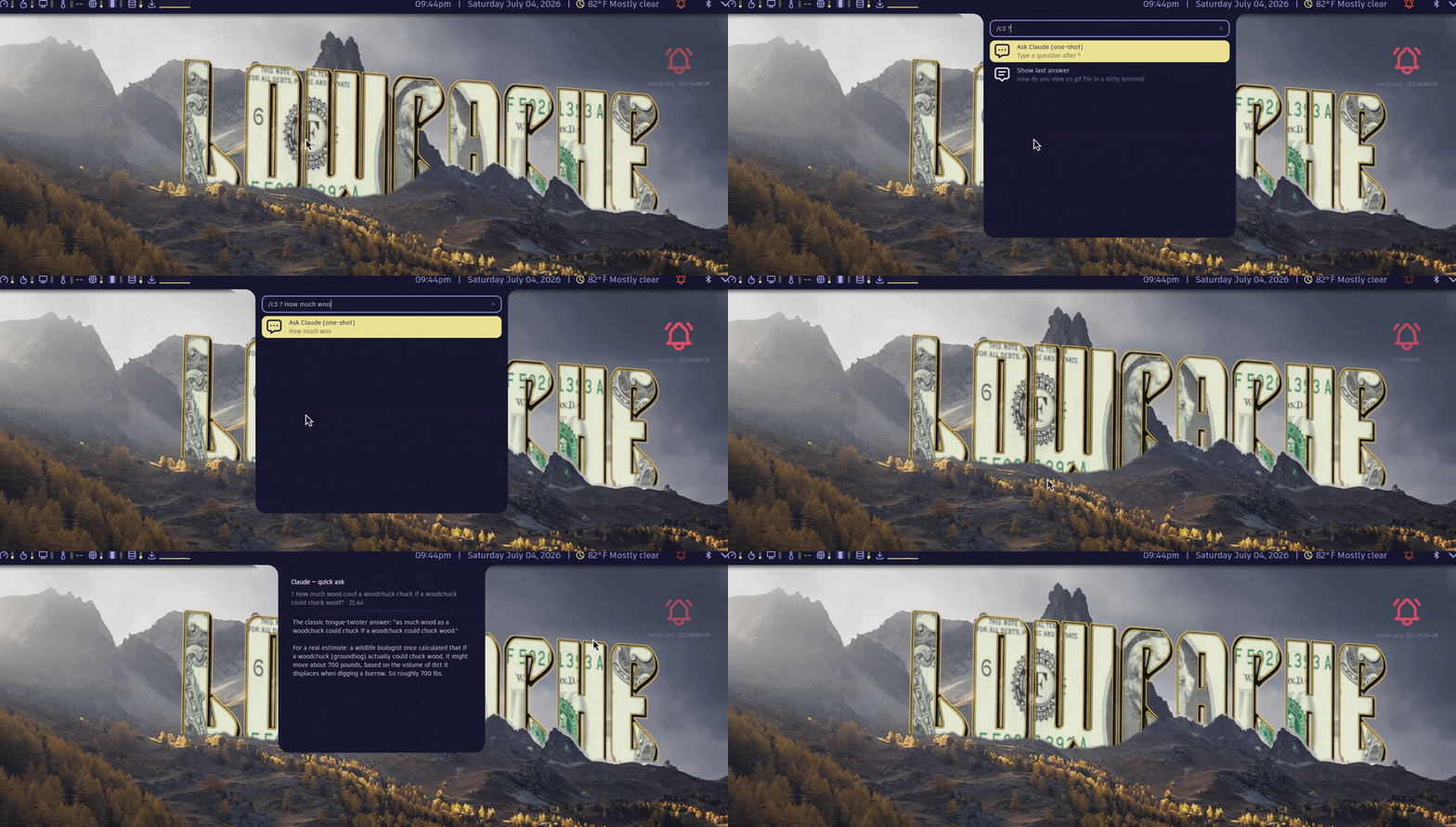
Ask something quick with /claude ? and the whole answer waits for you in the panel, instead of scrolling off the top of the terminal.
How it works
Perceive. shim/noctalia-mcp.py is a stdio MCP shim that hands Claude a live read on your machine: niri msg -j for the windows you have open, playerctl for what's playing, noctalia msg status for the state of the shell itself. Nothing to wire up by hand. Launch through /claude and it attaches itself.
Practice. Everything on the backend funnels through claude.luau, the /claude launcher and the one door in. It normalizes the event vocabulary, throws notify-send toasts, and calls noctalia msg to move panels around. One chokepoint on purpose — so when something acts up, there's exactly one place to go look. That file is registered twice: as the /claude launcher, and as a [[service]] under claude-ask. A launcher entry can't receive IPC, so the ask panel's poke needs the second registration to have somewhere to land — same file either way, so the read-only flags for a quick-ask still live in exactly one place.
Pulse. pulse-svc.luau is a headless [[service]] that runs the show. Hook events land here over IPC at lowcache/claude-companion:pulse-svc, and from there it does the rest: tracks every session at once, surfaces whichever one's most urgent, and publishes a rollup to shared state under claude.pulse for subscribers to read.
And downstream is where the surfaces live. pulse.luau on the bar and orb.luau on the desktop are independent subscribers that only render. Both watch claude.pulse — pulse.luau breathes the accent color and shows per-session tooltips, while orb.luau breathes the same state frame by frame, glyph and opacity riding a sine wave, tempo picking up as things get urgent. Neither holds hooks or logic of its own. answer.luau is the answer panel that catches a /claude ? reply and holds the whole thing: wrapped, scrollable, all the parts a toast lops off the end.
Requirements
- Noctalia 5.0.0 on a supported Wayland compositor — niri, Hyprland, or Sway. The shim detects which one is running and speaks its IPC; the widgets themselves are compositor-agnostic. You only need the CLI for the compositor you actually run —
niri,hyprctl(Hyprland), orswaymsg(Sway) — not all three. - Claude Code — the
claudeagent being visualized. Optional if you're driving the widgets from another agent via PROTOCOL.md. python3for the MCP shim (stdlib only, no pip installs)- On the PATH as the shim's senses need them:
playerctl,nmcli,notify-send,ps - For the generic shell adapter (
hooks/pulse-emit, only used when driving the widgets from a non-Claude agent):tris required;timeoutis optional — the adapter falls back to a direct dispatch when it's absent.
Install
# clone and symlink into the plugins dir
ln -s "$PWD" ~/.local/share/noctalia/plugins/claude-companion

# enable the plugin
noctalia msg plugins enable lowcache/claude-companion
Then, in order:
- (Optional) Put the
pulsewidget on a bar (Settings → Bar) for the glanceable dot — capture no longer depends on it; the headlesspulse-svcservice does the listening. - Add the
orbdesktop widget if you want the ambient presence. - Merge
hooks/settings.snippet.jsoninto~/.claude/settings.jsonso Claude's lifecycle hooks actually drive the pulse. - Point Claude at
shim/noctalia-mcp.pywith--mcp-configto hand it the senses and hands. (Sessions you launch through/claudedo this for you.) - (Optional) Turn on the consent gate — see Approving tools from the desktop. It ships off; the hook in step 3 is inert until you set
consent_mode.
Prove it works:
noctalia msg plugin lowcache/claude-companion:pulse-svc all needs_attention   # bar icon → red bell
noctalia msg plugin lowcache/claude-companion:pulse-svc all idle              # back to robot
[!WARNING]
pulseno longer has to stay on a bar. The sole aggregator is now the headlesspulse-svcservice, which starts with the shell and listens whether or not any widget is placed — so pulling thepulsedot off a bar just hides the glanceable icon; the orb keeps updating and hooks/IPC still land. This retires the old D10 requirement, made possible by the[[service]]entry kind added in the Noctalia 5 beta.
Usage
/claude <task> opens a real Claude Code session in your terminal, shim already wired in. Bare /claude picks up where you left off (claude --continue). And /claude ? <question> is the quick one — a read-only ask that comes back as a toast and lands, in full, in the answer panel.
That panel opens however you like it: click the pulse, use the "Show last answer" row under /claude, or toggle it from the CLI:
noctalia msg panel-toggle lowcache/claude-companion:answer
Leave it open and it refreshes live while suppressing the toast, so you're never reading the same answer twice. A click outside or Esc puts it away.
Hover the bar and the tooltip tells you where each session stands and what it's burning — input, output, cache reads. Run a few at once and you get a line per session plus a Σ total, with the icon always showing whichever one needs you most.
Middle-click the pulse to ask a one-off question without the launcher. Type, press Enter, done — no /claude, no ? prefix to remember. It runs the same read-only quick-ask path as /claude ? …, and the answer arrives the same way: the answer panel plus a toast.
noctalia msg panel-toggle lowcache/claude-companion:ask
Right-click the pulse for the sessions panel — the same rollup, but you can act on it. A tooltip disappears on the way to it; this doesn't. One row per live session with its state, model and burn, and a Retire button on each.
Retire is there for the one failure mode you'll actually hit: a session whose SessionEnd hook never fired — terminal killed, hook interrupted mid-distill — sits at idle forever and keeps inflating the count. Retiring it corrects the tally from the shell, without going back to a terminal. It adds no new protocol: a retire is the ordinary session_end event carrying that session's id, exactly what hooks/pulse.py sends.
noctalia msg panel-toggle lowcache/claude-companion:sessions
Settings
The plugin declares four user settings, read via noctalia.getConfig(<key>):
| Setting | Type | Range | Step | Default | Description |
|---|---|---|---|---|---|
breath_speed |
double | 0.25–3.0 | 0.05 | 1.0 | Phase-rate multiplier for the breathing animation on both the bar dot and the desktop orb. Higher = faster. |
pulse_glow_floor |
double | 0.0–0.9 | 0.05 | 0.45 | How dim the bar dot gets at the trough of its breath. 0 = dims to black, higher = stays brighter. |
orb_swell |
double | 0.0–3.0 | 0.05 | 1.0 | How far the desktop orb glyph magnifies as it breathes. 0 = static size, higher = a bigger swing. |
consent_mode |
select | off / learn / enforce | — | off |
The tool-consent gate. See Approving tools from the desktop. |
There are no color settings — both surfaces follow the active theme palette via accent role names (secondary, primary, error).
Approving tools from the desktop
Everything above is observation: the pulse tells you Claude is blocked, and you go find the terminal. The consent gate closes that loop — Claude asks, you answer on the desktop, and the tool runs or doesn't. You never leave what you were doing.
It is off by default and should stay off until you have read this section, because unlike the rest of the plugin it sits in the critical path of a tool call.
Set consent_mode in the plugin's settings:
| Mode | What happens |
|---|---|
off |
The hook exits immediately. Identical to not having it installed. |
learn |
Records what Claude runs. Never blocks, never prompts. |
enforce |
Anything not already allowlisted opens the consent panel and waits. |
Start in learn for a few days of normal work. It writes one line per gated tool
call to $XDG_STATE_HOME/noctalia/claude-companion/learn.jsonl, which is how the
allowlist gets seeded from traffic you actually produce instead of from anyone's
guess about what is safe. It sits beside the allowlist in durable state, not on the
runtime tmpfs, so a multi-day run survives the logouts it will certainly span.
When it has seen enough:
python3 hooks/consent.py promote # fold every observed command into the allowlist
promote is CLI-only and has no surface in the shell, so switching consent_mode
straight from learn to enforce in the settings skips it — and every command you
have ever run then stops to ask. Run it first.
Then switch to enforce. What the allowlist buys you is that those commands stop
opening the panel — it is not a grant of permission. The hook returns no decision
for them, so Claude Code applies its own permission rules exactly as it would
without this plugin. The gate can add a prompt; it never removes one.
What gets gated. Only the mutating tools — the matcher in
hooks/settings.snippet.json is ^(Bash|Write|Edit|NotebookEdit)$. Reads, greps and
globs are never gated and never invoke the hook at all. Widen or narrow it by editing
that matcher; it is your settings.json, not the plugin's.
The panel leads with the thing being authorised — the command, or for a path tool the path and the content it would write — because the description below it and the "Claude says" line are both written by the model whose action you are approving, and neither should caption it from above. Anything too long to fit is clipped with an explicit marker rather than silently cut. The presence line appears only while a single session is running, since it carries no session id and could otherwise describe a different session's work. Then the cwd and session.
Note that Always allow on a Write or Edit keys on the path, not the content:
you are approving "Claude may write this file", and a later write of different bytes to
the same path will not ask again. Bash keys on the exact command string, so it has no
such reach. Three answers: Allow once, Always
allow (appends to the allowlist), Deny. It opens itself when a request arrives and
closes when you answer; opening it by hand shows whatever is pending, or an empty state
when nothing is:
noctalia msg panel-toggle lowcache/claude-companion:consent
Nothing here classifies anything. The allowlist ships empty and only ever grows by
your explicit click, keyed on the exact command string. There is no pattern matching
and no shipped safelist, because a pattern is a security policy and shell composition
(git status && rm -rf ~) defeats one in a single line.
If anything goes wrong, the gate gets out of the way. Printing nothing is Claude
Code's "no decision, proceed normally", and every failure route takes it: Noctalia
offline (detected on dispatch, so it fails fast rather than waiting), no answer inside
the hook's 110s deadline, a response that doesn't echo the request nonce, a malformed
payload, an unhandled exception. In all of them Claude Code asks in the terminal
exactly as it did before. tests/consent_spec.py pins every one of those paths.
Forgery. Requests and responses live in $XDG_RUNTIME_DIR (0700, tmpfs, per-user)
at 0600, and each response must echo a nonce from its request. Without
XDG_RUNTIME_DIR the gate disables itself rather than fall back to a world-writable
/tmp, where any local process could drop an allow of its own.
[!NOTE] The allowlist lives at
$XDG_STATE_HOME/noctalia/claude-companion/allow.jsonland is meant to persist. On an impermanent root, make sure that path is on your persist list or you will re-approve everything after each boot.
IPC
Every entry id, and the exact command that reaches it. The plugin id is
lowcache/claude-companion; the part after the : is the entry id from plugin.toml.
Panels — answer, sessions, consent, ask:
noctalia msg panel-toggle lowcache/claude-companion:answer
noctalia msg panel-toggle lowcache/claude-companion:sessions
noctalia msg panel-toggle lowcache/claude-companion:consent
noctalia msg panel-toggle lowcache/claude-companion:ask
The pulse aggregator service — pulse-svc. Eight lifecycle events plus three control
events; payload is a single space-free CSV. Full contract in PROTOCOL.md:
noctalia msg plugin lowcache/claude-companion:pulse-svc all <event> [payload]
noctalia msg plugin lowcache/claude-companion:pulse-svc all needs_attention   # bar icon -> red bell
noctalia msg plugin lowcache/claude-companion:pulse-svc all idle              # back to robot
The quick-ask backend service — claude-ask. A bare poke; the question is written to
$XDG_RUNTIME_DIR/claude-companion/ask first, because a payload cannot contain spaces:
noctalia msg plugin lowcache/claude-companion:claude-ask all ask
Launcher provider — id claude, prefix claude. Type claude in the Noctalia
launcher to start a session, or claude ? <question> for a quick-ask.
The bar widget pulse and the desktop widget orb are pure subscribers to the
claude.pulse shared-state key and take no IPC of their own.
Wiring up other agents
None of this is Claude-specific under the hood. The pulse speaks a plain event format and doesn't care who's talking — any agent, CI job, or shell script that can run a command on its own lifecycle can light up the same bar. PROTOCOL.md has the full eight-event vocabulary, the CSV payload, session semantics, and the adapter contract. The reference emitter, hooks/pulse-emit, is plain POSIX sh and needs nothing but noctalia on your PATH:
hooks/pulse-emit turn_start mysess
hooks/pulse-emit turn_end mysess gpt-5 12000 800
hooks/pulse-emit session_end mysess
Notes
What it writes. Runtime files live in $XDG_RUNTIME_DIR/claude-companion/ (tmpfs,
0700, per-user): the consent mode mirror, the presence message, the ask handoff, and
consent/<id>.req|.res while a prompt is outstanding. Durable state lives in
$XDG_STATE_HOME/noctalia/claude-companion/ (0600): allow.jsonl and learn.jsonl for the
consent gate. The shim's memory tool also appends to ~/.memory/inbox/.
What it spawns. noctalia msg … for every dispatch; python3 for the lifecycle hooks,
the consent gate and the MCP shim; notify-send for toasts; claude -p for quick-ask only.
The shim reads the compositor through niri msg -j, hyprctl -j or swaymsg -t, and media
through playerctl — all read-only queries.
Network. The plugin makes none. Quick-ask spawns claude -p, which talks to Anthropic's
API exactly as Claude Code does from a terminal.
Compositors. Everything except the shim's window/workspace tools is compositor-agnostic. Those tools support niri, Hyprland and Sway, detected from the running socket.
Rough edges. A few things worth knowing before they surprise you:
- Plugin panels render at
Layer::Top, so an overlay window — a notification, a quake terminal, a polkit prompt — can sit on top of the answer panel. The answer's still there; clear the overlay and you'll see it. There's an upstream ask in for panel layer control. - Eight-digit hex alpha is ignored by bar widgets — brightness is done by scaling RGB toward black. (Earlier builds didn't fire
state.watchon bars, so the pulse polled; the Noctalia 5 beta fires it, so the bar dot is now event-driven like the orb.) - Builtin and wallpaper-generated palettes have no on-disk JSON, so those fall back to fixed accent colors. Custom and community palettes are followed live, rechecked every ~8 s.
- Quick-ask rides headless
claude -p, which doesn't refresh an expired OAuth login token — only an interactive session does (upstream). The plugin checks the token's expiry before launching and, instead of burning the request on a guaranteed 401, tells you to open a terminal Claude session first; a failure it couldn't predict gets the same message in place of the raw API error. - The MCP shim is a Python prototype. A compiled port is the intended endgame.
- The shim's memory tool drops notes into
~/.memory/inboxfor the memd curator to pick up. No memd, no reader — the files get written and simply sit there. It follows memd's Inbox Protocol v1.0 (INBOX-PROTOCOL.mdin the memd repo).
License
MIT, as declared in plugin.toml. Full text in the
upstream repository.
Versions
| Version | Plugin API | Updated |
|---|---|---|
| v1.5.1 latest | 3 | Sep 6, 2026 |
Older versions stay installable on a Noctalia release whose plugin API is below the latest version's.